Unraveling the Complexity: The Relationship Between Machine Learning and AI
When we discuss “artificial intelligence” (AI) and “machine learning” (ML), we often use the terms interchangeably. However, these are distinct but related concepts. Imagine AI as a large circle encompassing machines that can perform tasks that typically require human intelligence. Machine learning then becomes a prominent, yet smaller, circle entirely within the AI circle. It’s a method for achieving AI.
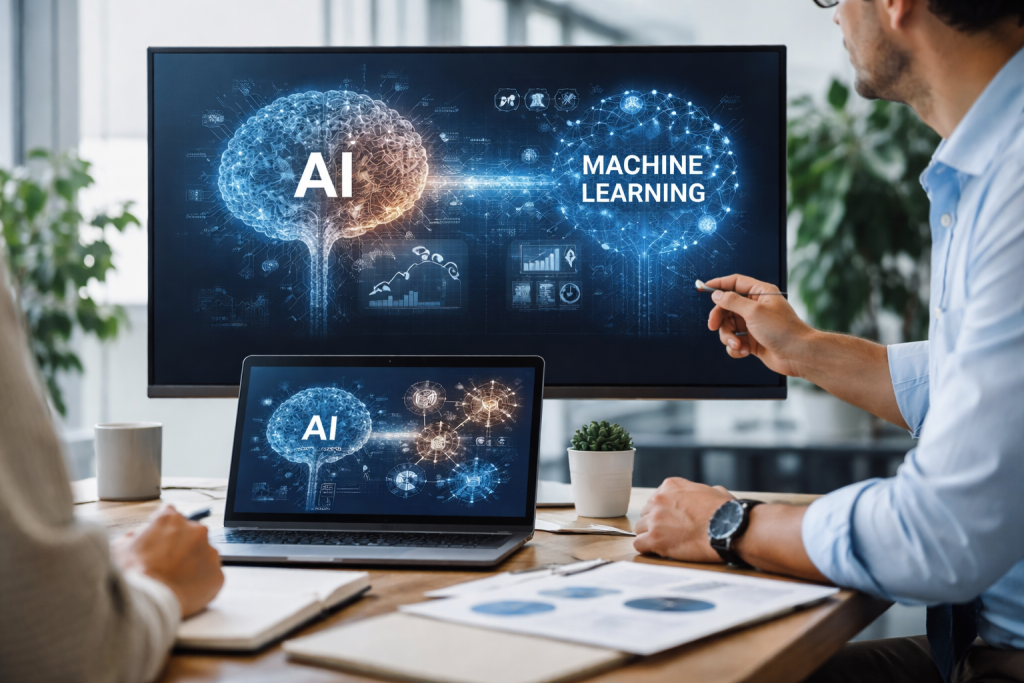
For example, if you build a machine that can play chess, that’s AI. If that machine learns to play chess better by analyzing past games, without being explicitly programmed with every possible move, that’s machine learning. This article will clarify what these terms mean, how they have developed, and their impact on our world.
Understanding the Basics: What is Machine Learning and AI?
To grasp the relationship, we must first define each term.
What is artificial intelligence?
Artificial intelligence refers to the simulation of human intelligence in machines. These machines are programmed to think like humans and mimic their actions. It involves several capabilities: learning, reasoning, problem-solving, perception, and language understanding. The goal of AI is to create intelligent agents that can perceive their environment and take actions that maximize their chance of achieving preset goals.
Early AI research focused on symbolic AI, where knowledge was represented using logical rules. For example, an expert system might have rules like “IF a patient has a fever AND a cough, THEN diagnose flu.” As computing power increased, statistical and sub-symbolic approaches gained prominence.
What is machine learning?
Machine learning is a subset of AI that enables systems to learn from data without explicit programming. Instead of being given step-by-step instructions for every scenario, a machine learning algorithm is fed a large amount of data. It then identifies patterns and relationships within that data. Based on these patterns, the algorithm can make predictions or decisions on new, unseen data.
Consider the task of identifying spam emails. You wouldn’t manually program rules for every possible spam phrase. Instead, a machine learning algorithm would be trained on a dataset of emails labeled “spam” and “not spam.” It learns characteristics that distinguish spam from legitimate messages, like frequent use of certain keywords or unusual sender addresses. Once trained, it can classify new emails with a high degree of accuracy. This ability to learn from experience is central to ML.
The Evolution of Machine Learning and AI: A Historical Perspective
The journey of AI and ML is a long one, marked by periods of great optimism and significant challenges.
Early Concepts and Foundations
The concept of intelligent machines dates back centuries in folklore and philosophy. However, the scientific pursuit of AI began in the mid-20th century. Alan Turing’s seminal paper “Computing Machinery and Intelligence” (1950) proposed the “Imitation Game” (now known as the Turing Test) as a criterion for intelligence. The Dartmouth Workshop in 1956 is widely considered the birth of AI as a field. Early AI programs included checkers players and problem solvers.
The AI Winters and Resurgence
The initial excitement around AI led to over-optimistic predictions. When these predictions failed to materialize due to limitations in computing power and data, funding dried up, leading to periods known as “AI winters.” These were characterized by reduced enthusiasm and limited progress.
However, research continued. Critical developments in algorithms, particularly in machine learning, and the exponential growth of computing power and data availability rekindled interest in AI in the late 20th and early 21st centuries. The rise of neural networks and deep learning specifically transformed the landscape.
The Deep Learning Revolution
Deep learning, a subfield of machine learning, involves artificial neural networks with multiple layers (“deep” networks). Inspired by the structure of the human brain, these networks can learn complex patterns from raw data. This breakthrough has enabled remarkable progress in areas like image recognition, natural language processing, and speech recognition. The ability of deep learning models to automatically learn features from data, without human intervention, makes them incredibly powerful.
The Interplay Between Machine Learning and AI: Exploring the Connection
As established, machine learning is a tool within the broader field of AI. It’s a powerful engine that drives many AI applications.
ML as a Method for Achieving AI
Think of AI as the destination—an intelligent system. Machine learning is one of the most effective vehicles for reaching that destination. Without machine learning, building complex AI systems would involve manually coding every rule and scenario, which quickly becomes intractable for real-world problems. ML allows AI systems to adapt, improve, and generalize from experience, making them more robust and capable.
AI Encompassing More Than Just ML
While ML is dominant, AI also includes other areas. For example, traditional expert systems, based on hand-coded rules, are a form of AI. Robotics, which involves the physical manifestation of intelligent agents, is another AI domain. Planning and search algorithms, even without learning, are core components of many AI systems. However, the performance and adaptability of these other AI branches are often enhanced by integrating machine learning components. For instance, a robot might use machine learning to perceive its environment or learn optimal navigation paths.
Applications of Machine Learning and AI: Real-world Examples
The impact of AI and ML is already woven into our daily lives, often without us realizing it.
Everyday Technologies
Consider your smartphone. Facial recognition to unlock your device, voice assistants like Siri or Google Assistant, and personalized recommendations for music or videos all leverage machine learning. When you search online, ML algorithms rank results based on relevance. Spam filters in your email client and fraud detection systems in banking networks rely heavily on ML.
Healthcare and Medicine
In healthcare, AI and ML are revolutionizing diagnostics and treatment. ML models can analyze medical images (X-rays, MRIs) to detect diseases like cancer with high accuracy. They assist in drug discovery by predicting molecular interactions and identifying potential drug candidates. AI-powered systems can also analyze patient data to predict disease outbreaks or personalize treatment plans based on a patient’s genetic profile and medical history.
Autonomous Systems
Self-driving cars are perhaps one of the most visible applications of AI and ML. These vehicles use perception systems (cameras, lidar, and radar) combined with deep learning algorithms to interpret their surroundings, detect objects, and navigate safely. Drones used for surveillance, delivery, or agriculture also employ AI for autonomous flight and mission execution.
Challenges and Limitations: Navigating the Complexity
While the capabilities of AI and ML are impressive, they are not without constraints and difficulties.
Data Dependency and Bias
Machine learning models are only as good as the data they are trained on. If the training data is biased, incomplete, or inaccurate, the model will learn and perpetuate those flaws. This can lead to discriminatory outcomes, for example, in facial recognition systems that perform poorly on certain demographics or algorithms that show biased job recommendations. Addressing data bias is a significant challenge.
Interpretability and Explainability
Many advanced machine learning models, especially deep neural networks, are often referred to as “black boxes.” It can be difficult to understand why a model made a particular decision or prediction. This lack of interpretability is a concern in high-stakes applications like medicine or law, where understanding the reasoning behind a decision is crucial for trust and accountability. Researchers are actively working on developing “explainable AI” (XAI) techniques to shed light on these internal workings.
Computational Resources and Energy Consumption
Training large-scale AI models, particularly deep learning models, requires immense computational power and energy. This raises concerns about environmental impact and accessibility. High computational costs can be a barrier for smaller organizations or researchers without access to supercomputing resources.
Robustness and Adversarial Attacks
AI models can be vulnerable to deliberate manipulation, known as adversarial attacks. Small, imperceptible changes to input data can cause a model to misclassify an image or make an incorrect prediction. Ensuring the robustness and security of AI systems is vital, especially in critical infrastructure.
The Future of Machine Learning and AI: Emerging Trends and Possibilities
The field of AI and ML is dynamic, with continuous innovation and new frontiers opening up.
Advanced AI Capabilities
We are seeing advancements in areas like natural language understanding, allowing AI to comprehend and generate human language with increasing sophistication. Reinforcement learning, where AI learns through trial and error in an environment, is leading to breakthroughs in robotics and game playing. Federated learning, which allows models to be trained on decentralized data without sharing the raw data itself, addresses privacy concerns.
AI in Science and Discovery
AI is becoming an indispensable tool in scientific research. It accelerates simulations, identifies patterns in complex datasets, and aids in the discovery of new materials and medicines. Consider its role in climate modeling or designing more efficient energy systems.
Human-AI Collaboration
The future likely involves more seamless collaboration between humans and AI. Instead of AI replacing humans, it will augment human capabilities. AI can handle repetitive tasks, process vast amounts of information, and provide insights, allowing humans to focus on creative problem-solving, strategic thinking, and tasks requiring emotional intelligence. This collaborative model promises greater efficiency and innovation.
Ethical Considerations: The Impact of Machine Learning and AI on Society
As AI and ML become more powerful and pervasive, addressing their ethical implications is paramount.
Privacy and Data Security
The reliance of ML on vast datasets raises significant privacy concerns. How is our data collected, stored, and used? Ensuring secure data handling, anonymization, and clear consent mechanisms are crucial to protect individual privacy. The potential for misuse of personal data by AI systems is a serious challenge.
Bias and Fairness
As previously discussed, algorithmic bias can lead to discriminatory outcomes. Society must establish frameworks and guidelines to ensure fairness in AI systems, especially in critical applications like hiring, lending, and criminal justice. Developers have a responsibility to audit their models for bias and actively work to mitigate it.
Accountability and Responsibility
When an AI system makes a mistake or causes harm, who is accountable? Establishing legal and ethical frameworks for attributing responsibility in AI-driven systems is complex. Is it the developer, the deployer, or the user? These questions need careful consideration as AI takes on more critical roles.
Automation and Employment
The increasing automation enabled by AI and ML will undoubtedly impact the job market. While some jobs may be automated, new jobs requiring different skills will likely emerge. Society needs to prepare for these shifts through education, reskilling programs, and discussions about future economic models. The goal should be to leverage AI to enhance human welfare, not diminish it.
FAQs
1. What is the difference between machine learning and AI?
Machine learning is a subset of AI that involves the use of algorithms and statistical models to enable machines to improve their performance on a specific task without being explicitly programmed. AI, on the other hand, refers to the broader concept of machines being able to carry out tasks in a way that we would consider “smart.”
2. How have machine learning and AI evolved over time?
The concept of AI dates back to ancient times, but the modern development of AI and machine learning began in the 1950s. Over the years, advancements in computing power, data availability, and algorithmic improvements have led to significant progress in the field.
3. What is the interplay between machine learning and AI?
machine learningMachine learning is a key component of AI, as it enables machines to learn from data and improve their performance on tasks. AI encompasses a broader range of capabilities, including reasoning, problem-solving, perception, and language understanding, of which Machine Learning is a subset.
machine learning4. What are some real-world applications of Machine Learning and AI?
learningMachine Learning and AI have a wide range of applications, including virtual personal assistants, recommendation systems, fraud detection, medical diagnosis, autonomous vehicles, and natural language processing, among others.
5. What are some ethical considerations related to machine learning and AI?
Ethical considerations related to machine learning and AI include issues such as bias in algorithms, privacy concerns, job displacement, and the potential for misuse of AI technologies. It is important to consider the societal impact of these technologies and ensure that they are developed and used responsibly.